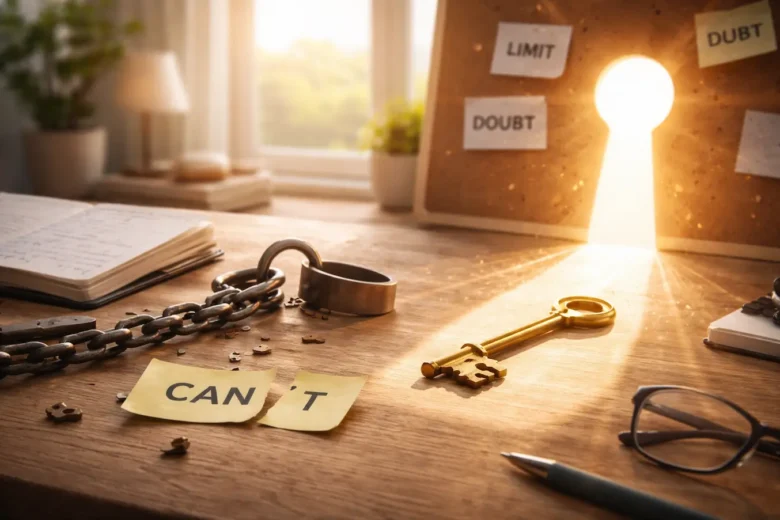
In today’s fast-moving world, many people assume that success depends mainly on opportunity, education, or access to resources. While those factors certainly matter, one of the most powerful forces shaping our lives is much less visible: our beliefs about ourselves.
Self-limiting beliefs are the internal assumptions we carry about our abilities, value, and potential. These beliefs often operate quietly in the background of our thinking, influencing the choices we make and the risks we avoid.
A person might say things like:
- “I’m not good at business.”
- “I’m too old to start something new.”
- “People like me don’t succeed in that field.”
When these thoughts repeat often enough, they begin to feel like facts rather than opinions. Over time, they can quietly shape our decisions, causing us to avoid opportunities that could help us grow.
The encouraging news is that these beliefs are not permanent. With awareness and consistent effort, it is possible to recognize them, challenge them, and gradually replace them with healthier, more realistic perspectives.
This guide explains practical ways to identify self-limiting beliefs and begin reshaping the way you think about your abilities and future.
Understanding What Self-Limiting Beliefs Are
A self-limiting belief is a conviction about yourself that restricts what you believe is possible. These beliefs usually sound absolute and final, as if they describe an unchangeable truth.
Common examples include
- “I’m just not a confident person.”
- “I always fail when I try something new.”
- “I’m poor with money.”
- “I don’t have the talent needed for that.”
The problem with these statements is that they frame abilities as permanent traits rather than skills that can be developed over time.
In reality, most personal abilities—communication, confidence, creativity, and leadership—can improve with practice and experience.
Where Limiting Beliefs Come From
Many limiting beliefs develop early in life. They may come from experiences, criticism, or repeated messages from others.
For example:
- A teacher once said, “You are not proficient at math.”
- A failed attempt at a project leads you to believe you are “not creative.”
- Watching others struggle financially leads you to believe success is unrealistic.
At the time, these experiences can feel very convincing. The brain naturally tries to protect us from embarrassment, rejection, or failure. Unfortunately, the protective conclusion often becomes overly broad.
A single negative event can turn into a long-lasting belief, such as “I’m incapable.”
Recognizing that these beliefs often come from past experiences—not objective reality—is the first step toward changing them.
Step 1: Identify the Beliefs Holding You Back
You cannot change something you are unaware of. The first step is simply noticing the thoughts that appear when you face a challenge or opportunity.
A productive exercise is to examine areas of life where you feel stuck.
Ask yourself questions such as:
- Why haven’t I pursued that goal?
- What am I telling myself about this situation?
- What assumption might be influencing my decision?
For example:
Career example:
“I haven’t applied for that promotion because I believe I’m not leadership material.”
Personal example:
“I avoid public speaking because I think I’m naturally terrible at it.”
Writing these beliefs down can be surprisingly powerful. Seeing them on paper often reveals how harsh or absolute they sound.
Step 2: Question the Evidence Behind the Belief
Once you identify a limiting belief, the next step is to examine it critically.
Our minds are excellent storytellers, but those stories are not always accurate. Many beliefs survive simply because we never question them.
Try asking yourself:
- What evidence actually supports this belief?
- What evidence contradicts it?
- Is this belief helping me or limiting me?
For instance, someone who believes they are “not a leader” might remember one failed experience while forgetting situations where they successfully organized projects, helped others, or solved problems.
Looking at the full picture often reveals that the belief is far less accurate than it first appeared.
Step 3: Reframe the Narrative
After challenging a belief, the next step is replacing it with a more constructive perspective.
This does not mean pretending everything is perfect or ignoring real challenges. Instead, it means shifting from a fixed mindset to a growth mindset.
A fixed mindset assumes abilities are permanent.
A growth mindset assumes abilities can develop through learning and practice.
For example:
Old belief:
“I’m terrible at presentations.”
New perspective:
“I’m still developing my presentation skills.”
A particularly useful technique is adding the word “yet.”
Instead of saying:
“I don’t understand this.”
Try saying:
“I don’t understand this yet.”
This minor alteration maintains the possibility of further progress.
Step 4: Take Small Actions That Challenge the Belief
Thoughts alone rarely change beliefs. Real change happens when new experiences provide evidence that contradicts the old narrative.
This is where small actions become powerful.
For example:
Belief: “I’m socially awkward.”
Action: Start a short conversation with someone in a casual setting.
Belief: “I’m not creative.”
Action: Spend time learning a new creative skill such as writing, drawing, or design.
Belief: “I can’t start a business.”
Action: Research one small idea or create a simple plan.
These actions do not need to be dramatic. Even small steps can gradually shift your self-perception.
Each positive experience becomes evidence that your previous belief was incomplete or inaccurate.
Step 5: Shape Your Environment
Our surroundings influence how we think more than we often realize.
If you constantly hear negative messages—whether from social media, news, or certain social circles—it becomes much harder to maintain a positive outlook.
Consider reviewing the information and influences in your daily life.
Helpful steps may include:
- Following educational or inspiring content instead of discouraging comparisons
- Spending time with people who encourage growth and learning
- Limiting exposure to environments that reinforce pessimistic thinking
A supportive environment does not eliminate challenges, but it can make it easier to maintain confidence and motivation.
The Importance of Self-Compassion
Changing long-standing beliefs takes time. There will be moments when old doubts resurface.
During those moments, self-compassion becomes important.
Instead of criticizing yourself for feeling uncertain, try acknowledging the difficulty of growth. Learning new skills or stepping outside familiar patterns naturally involves discomfort.
People who treat themselves with patience and understanding are often more willing to keep trying after setbacks.
Growth rarely follows a linear path. Progress usually comes from repeated effort, small adjustments, and persistence.
The Brain’s Ability to Change
One reason it is possible to overcome limiting beliefs is a concept known as neuroplasticity.
Neuroplasticity refers to the brain’s ability to reorganize and form new connections throughout life. Each time we practice a new way of thinking or behaving, we strengthen certain neural pathways.
Over time, new thought patterns can become more automatic.
In simple terms, the brain becomes better at the thoughts we practice most often.
If we repeatedly reinforce negative beliefs, they grow stronger. But if we consistently challenge those beliefs and practice new perspectives, the brain gradually adapts.
Examples of Reframing Common Limiting Beliefs
Here are a few examples of how limiting beliefs can be reframed into healthier perspectives.
Limiting belief:
“It’s too late for me to change careers.”
New perspective:
“Many people change paths later in life, and my experience can still be valuable.”
Limiting belief:
“I must be perfect before I start.”
New perspective:
“Starting imperfectly is part of the learning process.”
Limiting belief:
“I don’t have enough time.”
New perspective:
“I can start with small steps and prioritize what matters most.”
These shifts may seem simple, but they can dramatically influence how we approach opportunities.
Frequently Asked Questions
Could you please let me know how long it typically takes to change a limiting belief?
There is no single timeline. Research on habit formation suggests that new patterns often require several weeks or months of consistent practice. The key factor is repetition and persistence.
Are some limitations actually realistic?
Yes. Certain limitations are factual, such as physical constraints or time commitments. However, many beliefs that appear realistic are actually assumptions about what is possible.
The goal is to acknowledge reality and avoid restricting yourself unnecessarily.
Can professional guidance help?
Yes. Coaches, mentors, or licensed therapists can help people explore patterns of thinking and develop healthier perspectives. Deeply rooted beliefs can greatly benefit from professional guidance.
Final Thoughts
Self-limiting beliefs often operate quietly, shaping decisions without us realizing it. Over time, these internal narratives can influence career choices, relationships, and personal goals.
The beneficial news is that beliefs are not fixed. With awareness, reflection, and consistent action, it is possible to gradually reshape the way we evaluate our abilities.
Small steps—questioning assumptions, trying new experiences, and practicing a growth mindset—can lead to meaningful change.
Instead of asking yourself, “Why can’t I do this?” Try asking a different question:
“What is one small step I could take to begin?”
Sometimes that small step is all it takes to start building a new story about what you are capable of achieving.